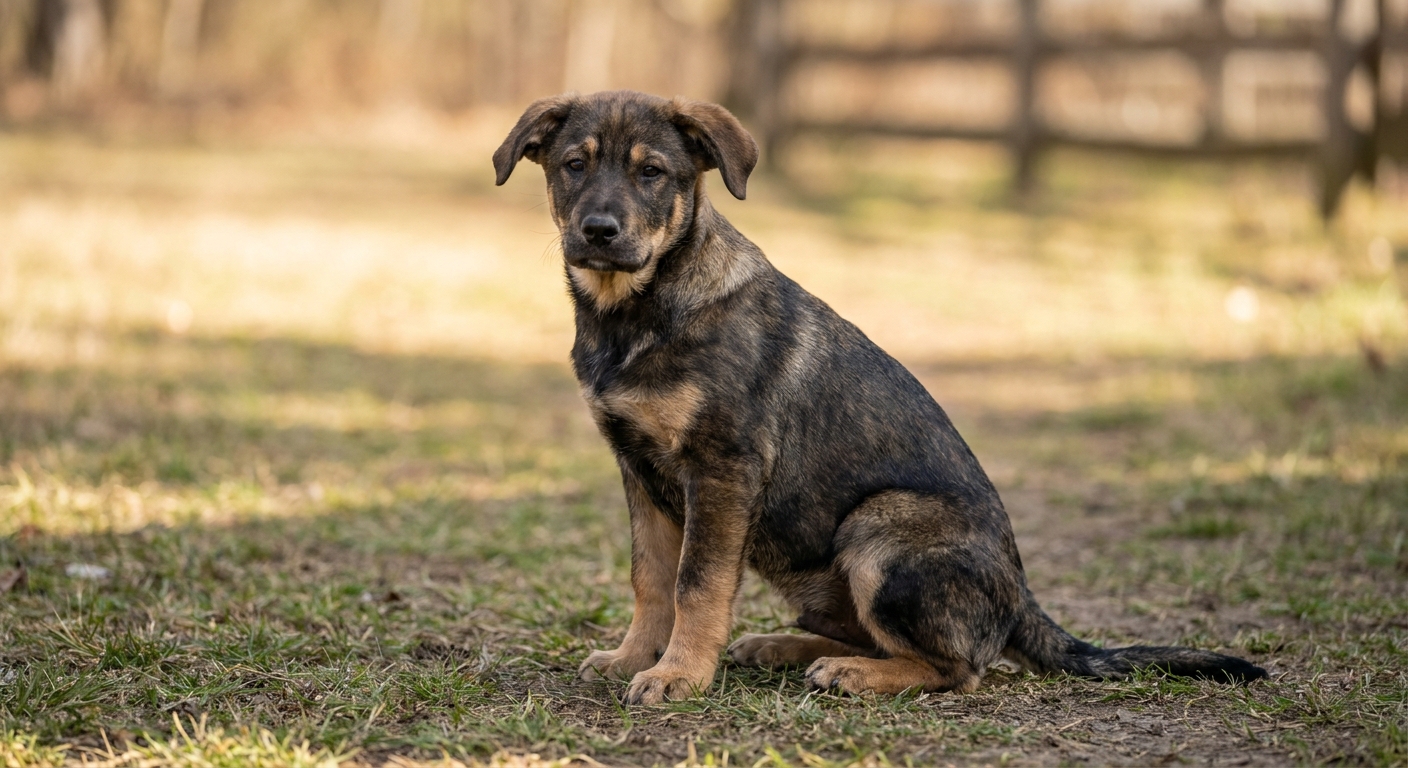
Meet Rocki
Picture this: a five-month-old, 25-pound whirlwind who has already decided that socks are treasure, walks are a constitutional right, and the world is absolutely, definitely, one hundred percent hers. That's Rocki. She arrived with big feelings, bigger opinions, and a genetic résumé that reads like the lineup at a very serious working-dog conference. She is soft where you expect tough, dramatic where you expect stoic, and deeply, thoroughly convinced that whatever she's doing right now is the most important thing that has ever happened in this house.
At five months old, Rocki is smack in the middle of the puppy chaos era — a stretch of life that is equal parts exhausting and completely unforgettable. She is learning everything simultaneously: how the world works, how people work, how socks work (currently her deepest area of academic study). The dog she's becoming is already visible if you know what to look for, and with a mix like hers, you're looking at something genuinely special. Rocki isn't the product of one breed's centuries of selective pressure — she's the product of four distinct ones, plus a wild card of ancient, untraceable mutt magic that probably makes her even more interesting than the sum of her parts.
So let's dig in. Consider this your field guide to the particular, wonderful, sock-obsessed creature currently sharing your home.
The breed mix, decoded
Rocki's DNA breaks down like this: 42% American Pit Bull Terrier, 23.7% Rottweiler, 13.6% Supermutt, 11.3% Doberman Pinscher, and 9.4% Labrador Retriever. That's a lot of working-dog royalty in one dog, with a splash of mystery for good measure. Here's what each piece probably brings to the table.
American Pit Bull Terrier (42%) — the heart of the operation
The biggest single chunk of Rocki is American Pit Bull Terrier, and if you've ever spent time with a well-loved APBT, you already know: these dogs are embarrassingly affectionate. They were bred to be people-oriented — fiercely, almost comically so — and that trait runs deep. At their best, Pit Bull Terriers are enthusiastic, joyful, physically exuberant dogs who genuinely want to be near their people at all times. Like, all times. Bathroom included, if you let them.
That APBT foundation is probably why Rocki cries when she sees the leash. Not because she's anxious, but because she is so full of feelings that the possibility of a walk — and all the togetherness and sniffing and adventure a walk represents — is almost too much to contain in a 25-pound body. That emotional expressiveness? That's classic Pit Bull energy. She doesn't have feelings so much as she is feelings, temporarily organized into a dog shape.
APBTs also tend to be physically tough, bouncy, and surprisingly gentle with people they love. They're often described as having a clown streak — genuinely goofy, self-aware in their silliness, happy to make you laugh. Rocki's inner clown is probably already making regular appearances.
Rottweiler (23.7%) — the quiet confidence
Nearly a quarter of Rocki is Rottweiler, and that's not a small thing. Rottweilers are one of the oldest working breeds on record — cattle herders, cart pullers, guard dogs for Roman legions — and they carry that history in their bones. What it tends to produce in a dog's personality is a certain calm authority, a watchful quality, and a deeply loyal attachment to their family that borders on devotion.
The Rottweiler influence in Rocki will probably show up as a kind of groundedness under all that Pit Bull enthusiasm. There may be moments — especially as she matures — where she settles into herself in a way that feels almost regal. A steadiness. A you-and-me-against-the-world loyalty that makes her feel less like a pet and more like a partner. Rottweilers are also famously funny in their own way — they have a dry, almost sardonic sense of humor, and they tend to be velcro dogs who follow their people from room to room with a dignified air of supervision.
The Rottie in Rocki will also probably contribute some of that natural watchfulness — an awareness of her surroundings, a tendency to notice things, a slightly more reserved initial reaction to strangers compared to the pure Lab golden-retriever-everybody-is-my-best-friend approach. That's not a bad thing. That's a dog who trusts thoughtfully.
Doberman Pinscher (11.3%) — the sharp edge
Dobermans are sharp — sharp as in intelligent, sharp as in alert, sharp as in they notice everything and process it faster than most. Bred specifically to be a working personal protection dog, the Doberman is often described as the dog that thinks like a human. They're sensitive, intensely bonded to their person, and almost uncannily perceptive about emotional states. They know when you're sad before you do.
Rocki's Doberman slice — just over 11% — probably contributes to her emotional attunement. The crying-at-the-leash behavior could easily have a little Dobie drama in it. Dobermans are not stoic dogs. They feel things intensely and they are not embarrassed about expressing that. Mixed with APBT expressiveness, that Doberman sensitivity might mean Rocki is especially tuned in to your moods, your routines, and especially any deviation from said routines that might possibly, potentially mean she's missing out on something.
Dobermans also tend to add a streak of athleticism and physical elegance that can really sharpen up a mixed-breed dog's movement and presence. Don't be surprised if Rocki, as she grows, has a particularly striking, purposeful way of moving through the world.
Labrador Retriever (9.4%) — the sprinkle of sunshine
It's only 9.4%, but don't underestimate the Lab's contribution. Labradors are the world's most popular dog breed for a reason — they're optimistic, food-motivated, eager to please, and they carry a fundamental goodwill toward the universe that is almost philosophically inspiring. That Lab sprinkle in Rocki's DNA is probably acting like a dash of salt in a recipe: a small percentage, but one that brightens and balances the whole thing.
It may show up in Rocki's retrieving instincts (or her interest in carrying things, which, combined with the sock obsession, tracks very nicely), her enthusiasm around food, and a generally sunny baseline mood. Labs also tend to love water, love swimming, love anything wet — that may or may not have surfaced yet, but it's in there somewhere.
Supermutt (13.6%) — the wild card
That 13.6% Supermutt designation is what DNA tests call it when there are trace amounts of so many different breeds that no single one rises to a meaningful percentage. It's basically Rocki's mystery chapter — the genetic whispers of dogs whose stories have been blended and diluted across generations until they're unidentifiable but still, quietly, present. Supermutt dogs often carry something that's hard to name but easy to feel: a certain adaptability, a resilience, a kind of genetic richness that purebred dogs sometimes lack. It's the part of Rocki that might surprise you sometimes — a behavior or instinct that doesn't quite fit any of the named breeds — and that's kind of wonderful. She has secrets even the science can't fully explain.
A note on Rocki's grown-up size
Here's the fun speculation portion of our program. At five months old and 25 pounds, Rocki is very much mid-construction. American Pit Bull Terriers typically land somewhere in the 30–60 lb range as adults, with females on the smaller end of that. Rottweilers are substantially bigger — females usually range from 80–100 lbs. Dobermans tend toward 60–90 lbs for females. Labradors sit in the 55–70 lb range.
Average those breeds together, weight them roughly by their percentages, and Rocki probably tends toward the 50–75 lb range as a fully grown adult — though that's genuinely just educated speculation, not a promise. A dog with Rottweiler in the mix can surprise you on the upside. She's five months old and already 25 pounds, which suggests she has a solid amount of growing still to do. Whatever size she lands at, she's almost certainly going to be a substantial presence — physically confident, well-muscled, the kind of dog whose energy fills a room even when she's sitting still. Plan your couch space accordingly.
Likely personality quirks
You've already identified two of Rocki's signature quirks — the sock fixation and the leash dramatics — and honestly, they're both extremely on-brand for this particular genetic cocktail. But there are probably more where those came from. Here's what you might see developing as Rocki grows:
- Sock hoarding (obviously). This is Rocki's current passion project and it's not going away on its own. A mix of APBT oral fixation, possible Lab retrieving instinct, and some generalized puppy need to have something in her mouth at all times has apparently converged on footwear as the preferred medium. She's not being destructive so much as she is curating a collection. She will probably expand to other soft items over time — dish towels, stuffed animals, the occasional shoe — and she may develop a specific ritual around the acquisition and display of these items.
- Leash dramatics that would earn an Oscar. The crying, the anticipation, the complete inability to regulate her excitement when a walk is possible — this is a feature, not a bug. Dogs with this level of emotional expressiveness tend to be deeply communicative, which is actually a gift once you learn to read each other. You'll probably get very good at knowing exactly what Rocki is feeling at any given moment, because she will never, ever keep it to herself.
- Velcro dog behavior. With that Rottweiler loyalty and APBT people-obsession stacked together, Rocki likely follows her people around the house and considers alone time a personal insult. She may pick one person as her primary anchor — her person — and orbit them with a devotion that is both touching and occasionally inconvenient when you need to use the bathroom.
- Selective suspicion of strangers. Not aggression, but watchfulness. The Rottweiler and Doberman in Rocki both contribute a tendency to take a beat before deciding someone is trustworthy. She may be less immediately approach-everyone-at-the-park than a pure Lab would be, and that's fine — that's just her doing her due diligence. Once she's decided you're good people, though, she will inform you enthusiastically.
- Sensitivity to household mood. That Doberman emotional attunement mixed with APBT empathy means Rocki probably picks up on tension, sadness, or stress in her people and responds to it — either by leaning in harder, getting silly to lighten the mood, or getting a little clingy. She's not going to miss it when something's off.
- A dramatic flair for emphasis. Whether it's a groan when she's asked to get off the couch, a theatrical flop when told no, or a very pointed stare when dinner is ten minutes late — Rocki probably has opinions and she voices them. Not in an aggressive way. Just in an I want you to know how I feel about this way.
- Play bowing at inanimate objects. This is classic puppy behavior across many breeds, but Pit Bull mixes are particularly prone to being baffled by and deeply intrigued by things like garden hoses, their own reflection, and the sound of a crinkly bag. Rocki may bow at things that don't bow back, and she may find this genuinely confusing.
How they probably like to play
Rocki is going to be a player. This is not a dog who will be satisfied with a gentle stroll and a quick sniff. She has working-dog energy stacked four breeds deep, and at five months old she's running on the purest, most concentrated form of that energy that she will ever have. Here's what her play style probably looks like now and as she matures:
Right now, at the puppy stage, Rocki likely plays hard and crashes harder. APBT puppies in particular have a notorious on/off switch — they will tear around the house like a tornado for twenty minutes and then collapse in a heap on your lap and be completely unconscious for an hour. That switch is a gift. Use it. A well-exercised Rocki is a sleepy Rocki, and a sleepy Rocki is significantly less likely to locate a new sock.
Rocki likely enjoys tug-of-war with an enthusiasm that is slightly alarming for her size. APBTs were historically bred with strong jaws and a hold-and-shake instinct, and tug tends to tap right into that. A good, sturdy tug toy — not your sleeve, not your shoelace, but an actual tug toy — is probably one of the best investments you can make right now. It gives that instinct an appropriate outlet and doubles as a great bonding activity.
The Lab DNA in Rocki may mean she has more interest in fetch than the average Pit Bull mix. She might not have a perfect retrieve yet — she may fetch the ball and then run away with it, which is technically more of a keep-away — but the chase instinct is probably there. Experiment with a ball or a flirt pole and see what lights her up.
That Rottweiler working-dog brain means Rocki will probably also love games that make her think. Puzzle feeders, sniff work, hide-and-seek with treats or toys — these are the kinds of games that tire her out mentally as well as physically, and mental tiredness is real and valuable. A dog who's had to work her brain for twenty minutes is often calmer than one who's just sprinted for an hour.
As she gets older and fills out, Rocki will likely appreciate activities that give her body and brain a workout simultaneously. Scent work, agility, hiking, even structured play sessions in a fenced yard — these kinds of activities will suit her working-dog heritage much better than a short on-leash walk around the block. She's going to be a dog who needs real exercise to be her best self, and she will tell you, loudly and expressively, when she hasn't had enough.
Socially, Rocki probably enjoys playing with other dogs — with the caveat that her play style may be intense by some dogs' standards. APBTs and their mixes often play in a very full-contact, bouncy, mouthy way that some more reserved dogs don't love. Dog-to-dog play is great; just make sure her playmates can match her energy and communication style, and watch body language on both sides. Rocki probably reads other dogs' signals, but as a puppy, she's still learning the grammar.
Training tendencies
Here's the thing about Rocki from a training standpoint: she has a genuinely excellent hand to play. She has the people-orientation of the APBT, which means she wants to please the humans she loves. She has Lab influence, which means she's likely food-motivated, and food motivation is basically a cheat code for teaching new things. She has the Doberman intelligence, which means she can learn quickly. And she has the Rottweiler steadiness, which means once she knows something, she tends to know it.
The challenges are equally predictable: that same intelligence means she gets bored fast. Repetition without purpose will lose her quickly. She's going to need training to feel like a game, not a drill. Short sessions, high value treats, lots of variety, and a handler who stays interesting and engaged will get much further with Rocki than someone who runs the same five commands in a row every day until everyone is bored to tears.
At five months old, Rocki is in one of the most important training windows of her life. She's past the very first fear imprint stage and into the period where everything she learns about the world is going to stick. This is the time to expose her to as many different people, places, sounds, surfaces, dogs, and experiences as possible — not to overwhelm her, but to show her that the world is generally fine and she doesn't need to be suspicious of it. Socialization at this stage pays dividends for the rest of her life, especially with a mix that has some natural watchfulness baked in.
The leash dramatics are worth acknowledging here: a dog who gets that worked up about walks has a lot of emotional energy wrapped up in the ritual of Going Out. That can actually be used in training — she's telling you that the walk is extremely high value to her, which means you have leverage. Teaching a calm sit before the leash goes on, for example, uses her own walk-desire as the reward. She'll figure that out relatively quickly because the payoff is enormous to her.
The sock obsession is similarly useful information. Rocki has a strong oral drive and likes having things in her mouth. That's not a character flaw; that's a trainable trait. Teaching a solid "trade" or "drop it" cue early — exchanging the sock for a treat, consistently and without drama — builds a habit that will serve you well for the rest of her life. Dogs who know a reliable trade are dogs who don't guard resources, and that's a very good thing to establish before she's 60 pounds.
Rocki will likely respond best to positive, reward-based training that treats her like the smart, feeling creature she is. With the sensitive Doberman streak and the emotionally intense APBT core, harsh corrections or punitive training approaches are more likely to create confusion and shut her down than to produce the behavior you want. She wants to get it right. She wants to be good for you. Make it clear what "right" looks like, reward it enthusiastically, and Rocki will meet you more than halfway.
Patience with the puppy chaos is also worth mentioning. At five months old, her impulse control is still very much under construction — that's not a training failure, that's just a puppy brain doing what puppy brains do. Consistency now, even when progress feels slow, is what builds the calm, confident, well-mannered dog she's absolutely capable of becoming.
Things to keep an eye on
This section is offered in the spirit of informed observation, not alarm. These are the kinds of things that can be common in Rocki's breed mix — not predictions, not diagnoses, just things worth keeping a friendly eye on and discussing with your veterinarian as she grows.
Large, muscular working breeds like Rottweilers and Pit Bull Terriers can sometimes be prone to joint-related concerns — things like hip and elbow dysplasia tend to come up in conversations about these breeds. In a mix like Rocki's, where she may be heading toward a solidly built medium-to-large adult size, it's worth asking your vet about appropriate exercise during puppyhood (growing joints and high-impact repetitive exercise don't always mix well) and discussing what screening might make sense as she matures. This is very much a "ask your vet" topic rather than a cause for immediate concern.
Doberman Pinschers are known to sometimes carry certain hereditary heart conditions as a breed — again, worth being aware of as a background fact and something a vet familiar with her history can monitor over time. This is not a prediction for Rocki specifically; it's just the kind of breed-linked awareness that helps you have useful conversations with your veterinarian.
Deep-chested breeds — and Rocki's mix includes a few — can occasionally be associated with bloat (gastric dilatation), which is something to have a general conversation about with your vet, particularly around feeding practices and exercise timing. Again: not a prediction, just a talking point.
From a behavioral-wellness perspective: Rocki's emotional expressiveness and deep bonding tendencies mean she may be susceptible to separation-related stress if not gradually taught that being alone is okay and temporary. Building in short, positive alone-time experiences now — while she's young and the world is still being defined for her — is one of those small investments that can prevent a much bigger challenge later.
And on the subject of the sock obsession: keep an eye on what she's doing with the socks. Carrying them around and presenting them to you like gifts is one thing. Eating them is another matter entirely and is the kind of thing that warrants a vet call. Puppies with strong oral drives sometimes swallow things that don't agree with their digestive situation, and socks are unfortunately high on the list of reported foreign body culprits. If Rocki is a swallower rather than a carrier, make sure socks and similarly tempting soft items are out of reach when unsupervised.
As always: your veterinarian is the right person to talk to about any of this in specific, personalized terms. The above is just the view from the breed-blend level — a prompt for good conversations, not a cause for worry.
Celebrity dog comparison
Rocki's celebrity dog counterpart is, without question, Chance from Homeward Bound: The Incredible Journey.
Chance is an American Bulldog mix with the emotional range of a Shakespearean actor and the impulse control of a golden retriever puppy at a birthday party. He is simultaneously brave and ridiculous. He runs headfirst into situations before fully thinking them through. He is intensely loyal to the people he loves. He has enormous feelings and communicates them at volume. He gets himself into trouble specifically because he's so enthusiastic about everything. And despite the chaos, despite the sock-equivalent mischief, despite the dramatics — you would not trade him for anything.
That's Rocki. That's absolutely Rocki.
She has the heart of a hero wrapped in a package that is currently in the business of stealing footwear and crying at leashes. She will grow into herself. She will channel all that energy and feeling and loyalty into being an absolutely extraordinary companion. But right now, in this moment, she is pure Chance energy: all in, all feeling, completely convinced that whatever is happening right now is the most important thing that has ever happened, and deeply, genuinely glad that you're there to experience it with her.
Rocki's vibe in three words
- Loyal to the bone.
- Dramatically, joyfully alive.
- Chaos with a heartbeat.
This report is for entertainment only and is not veterinary advice. Always consult a licensed veterinarian for health concerns.